

The franchise agreement without (heavy demands on) know-how
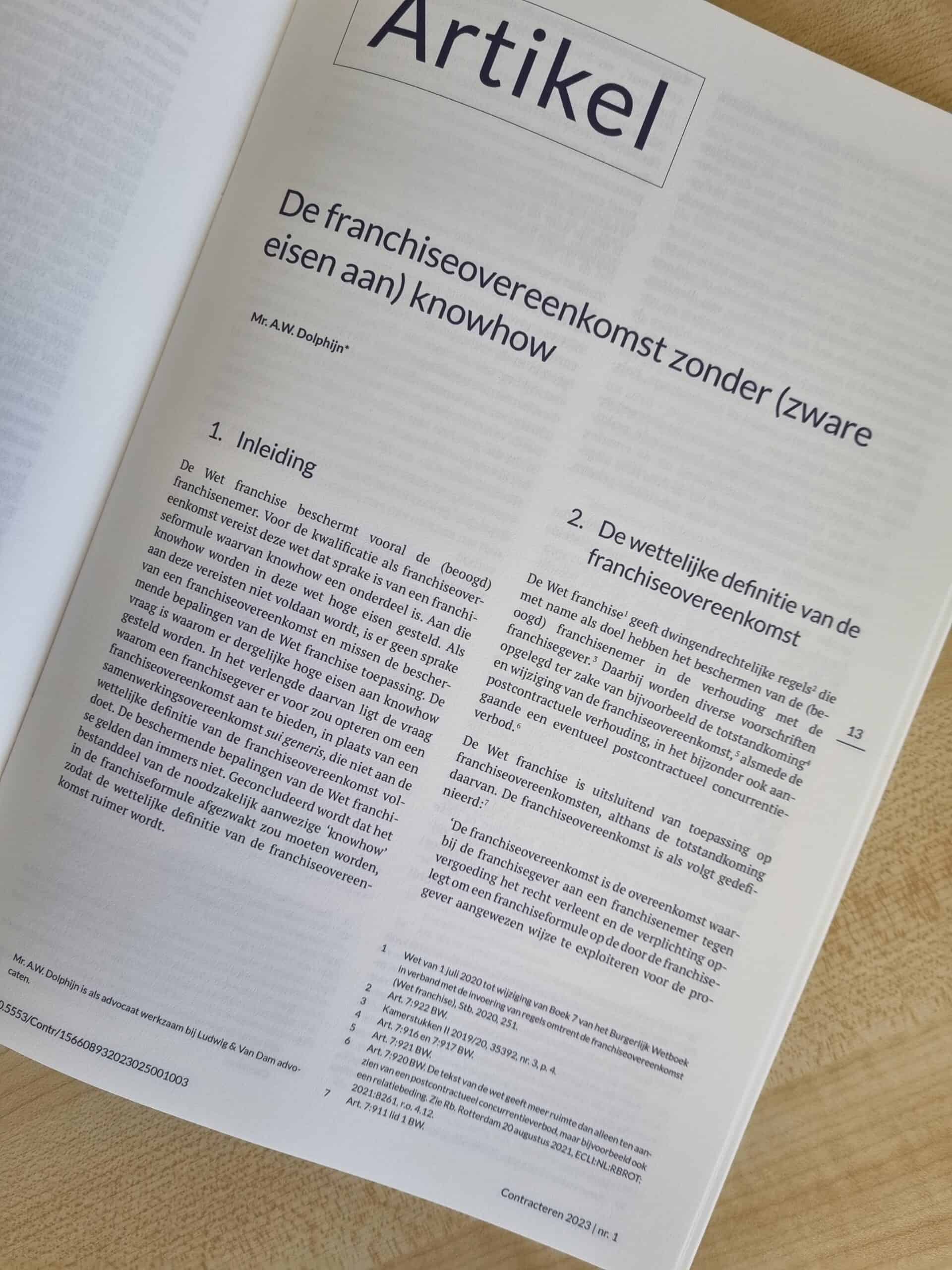
In the 2023-1 edition of Contracting magazine, I published a contribution entitled: “The franchise agreement without (strict requirements for) know-how”.
For the qualification as a franchise agreement, the Franchise Act requires that there is a franchise formula of which know-how is a part. This law places high demands on this know-how. If these requirements are not met, there is no franchise agreement and the protective provisions of the Franchise Act are missing. The question is why such high demands are placed on know-how. It is concluded that the element of the necessarily present ‘know-how’ in the franchise formula should be weakened, so that the legal definition of the franchise agreement becomes broader.
The article can be ordered here from the publisher Boom Uitgevers.
Ludwig & Van Dam lawyers, franchise legal advice.
Do you want to respond? Then email to dolphijn@ludwigvandam.nl
Other messages
Developments in competition law
Some time ago, the Netherlands Competition Authority (NMa) made a groundbreaking ruling that is of great importance to all franchise organizations in the Netherlands.
Transfer Arrangements
Franchise agreements usually include transfer arrangements
The right to the formula name upon termination of the franchise relationship
In practice, discussions regularly occur when the franchise relationship is terminated between a franchisor and one or more franchisees
The possibility of actively or not actively recruiting customers outside
Based on the relevant regulations, active recruitment activities by the franchisee are permitted
Customers, clientele and exceptions thereto
Some franchise constructions have the characteristic that the products or services in question are only supplied to certain consumers.
Intellectual property rights
In general, the nature of a franchise relationship implies that, on the basis of a franchise agreement