

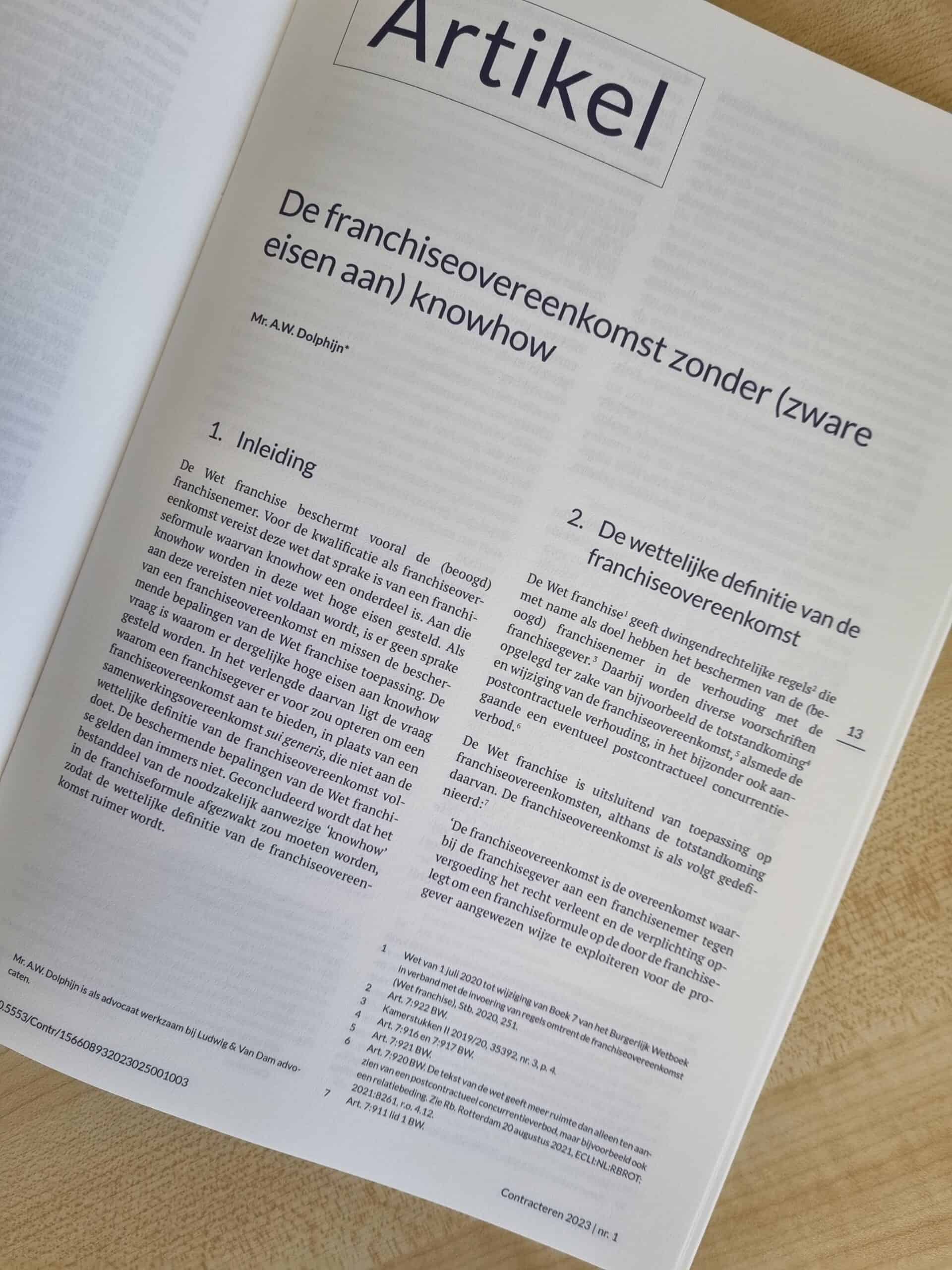
The franchise agreement without (heavy demands on) know-how
In the 2023-1 edition of Contracting magazine, I published a contribution entitled: “The franchise agreement without (strict requirements for) know-how”.
For the qualification as a franchise agreement, the Franchise Act requires that there is a franchise formula of which know-how is a part. This law places high demands on this know-how. If these requirements are not met, there is no franchise agreement and the protective provisions of the Franchise Act are missing. The question is why such high demands are placed on know-how. It is concluded that the element of the necessarily present ‘know-how’ in the franchise formula should be weakened, so that the legal definition of the franchise agreement becomes broader.
The article can be ordered here from the publisher Boom Uitgevers.
Ludwig & Van Dam lawyers, franchise legal advice.
Do you want to respond? Then email to dolphijn@ludwigvandam.nl
Other messages
Is franchising always the right form of cooperation?
Franchising is in most cases a form of cooperation that involves all parties involved
Intellectual property: get it right
Franchisors and franchisees also have to deal with what is so nicely called intangible products of the mind.
The preliminary agreement
The European Code of Honor on Franchising has already been discussed in this series of articles.
Sale of the franchise organization, consequences for the franchisees?
Last week it was announced that the HEMA organization may be sold by Maxeda, the owner of the organization.
Indemnification II – Failed Forecasts
A special form of indemnification consists of exoneration clauses that attempt to indemnify the franchisor against incorrect forecasts.
Incorporation of the franchisee’s business into a private limited company
When the franchisor and franchisee conclude their franchise agreement, in most cases there are franchisees