

The franchise agreement without (heavy demands on) know-how
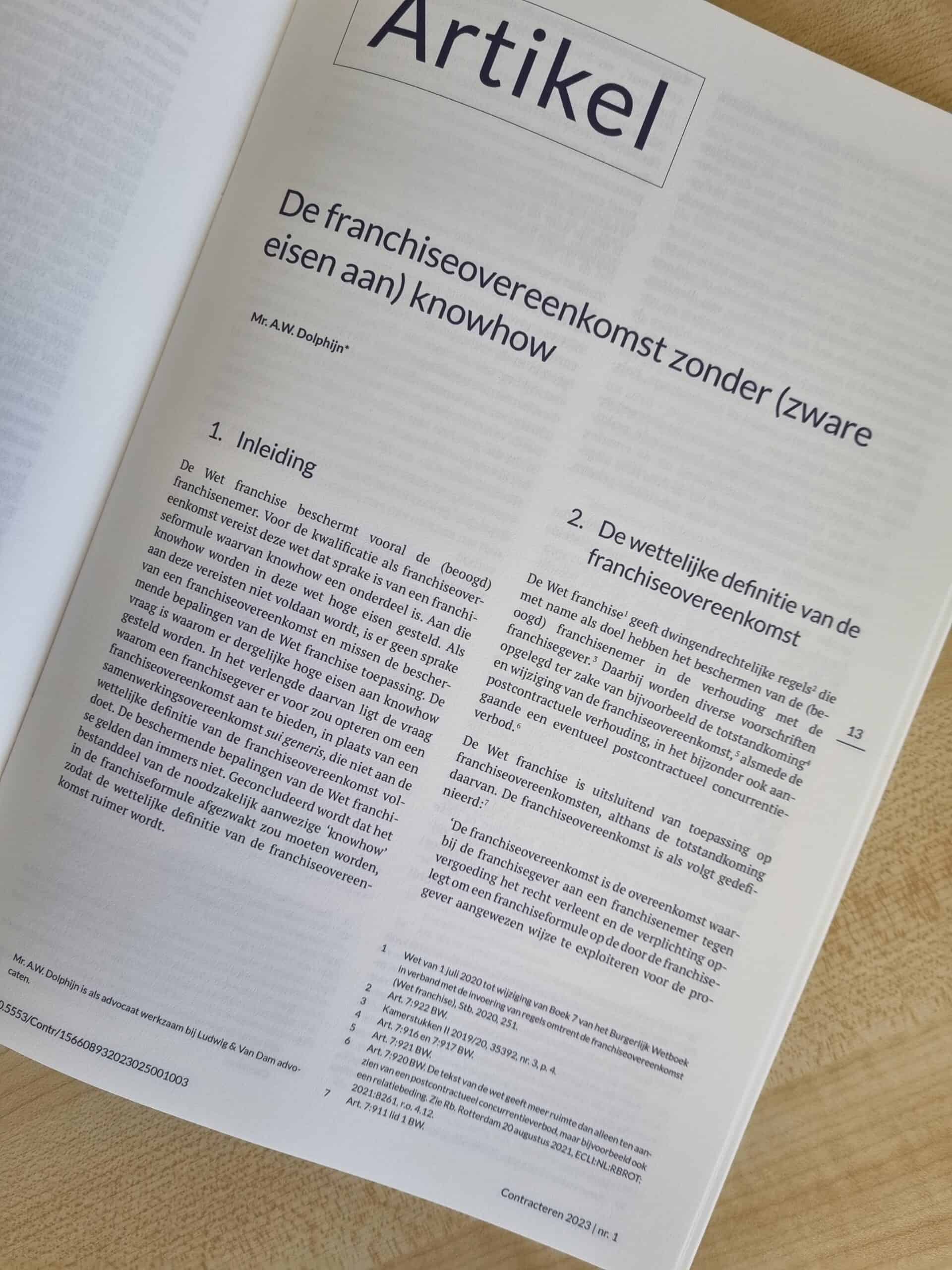
In the 2023-1 edition of Contracting magazine, I published a contribution entitled: “The franchise agreement without (strict requirements for) know-how”.
For the qualification as a franchise agreement, the Franchise Act requires that there is a franchise formula of which know-how is a part. This law places high demands on this know-how. If these requirements are not met, there is no franchise agreement and the protective provisions of the Franchise Act are missing. The question is why such high demands are placed on know-how. It is concluded that the element of the necessarily present ‘know-how’ in the franchise formula should be weakened, so that the legal definition of the franchise agreement becomes broader.
The article can be ordered here from the publisher Boom Uitgevers.
Ludwig & Van Dam lawyers, franchise legal advice.
Do you want to respond? Then email to dolphijn@ludwigvandam.nl
Other messages
Price maintenance always leads to nullity?
Under competition law, it is not permitted to include so-called resale price maintenance in franchise agreements
Again turnover-related rent
In an earlier contribution to First Formula (November 10, 2006) about turnover related issues, I asked the question whether unilateral change
Turnover and result: the principle of prudence
In various countries in the world, franchising is subject to increasingly stringent regulations.
How is the (sub)lease agreement concluded?
As is well known, tenancy law is largely subject to (semi) mandatory law.
Advantages and disadvantages of the turnover-related rent
A commonly used construction in franchise relationships is where the franchisee owns the premises in which he operates his business
Recent jurisprudence
Discussion deserves a recent ruling by the Court in preliminary relief proceedings.