

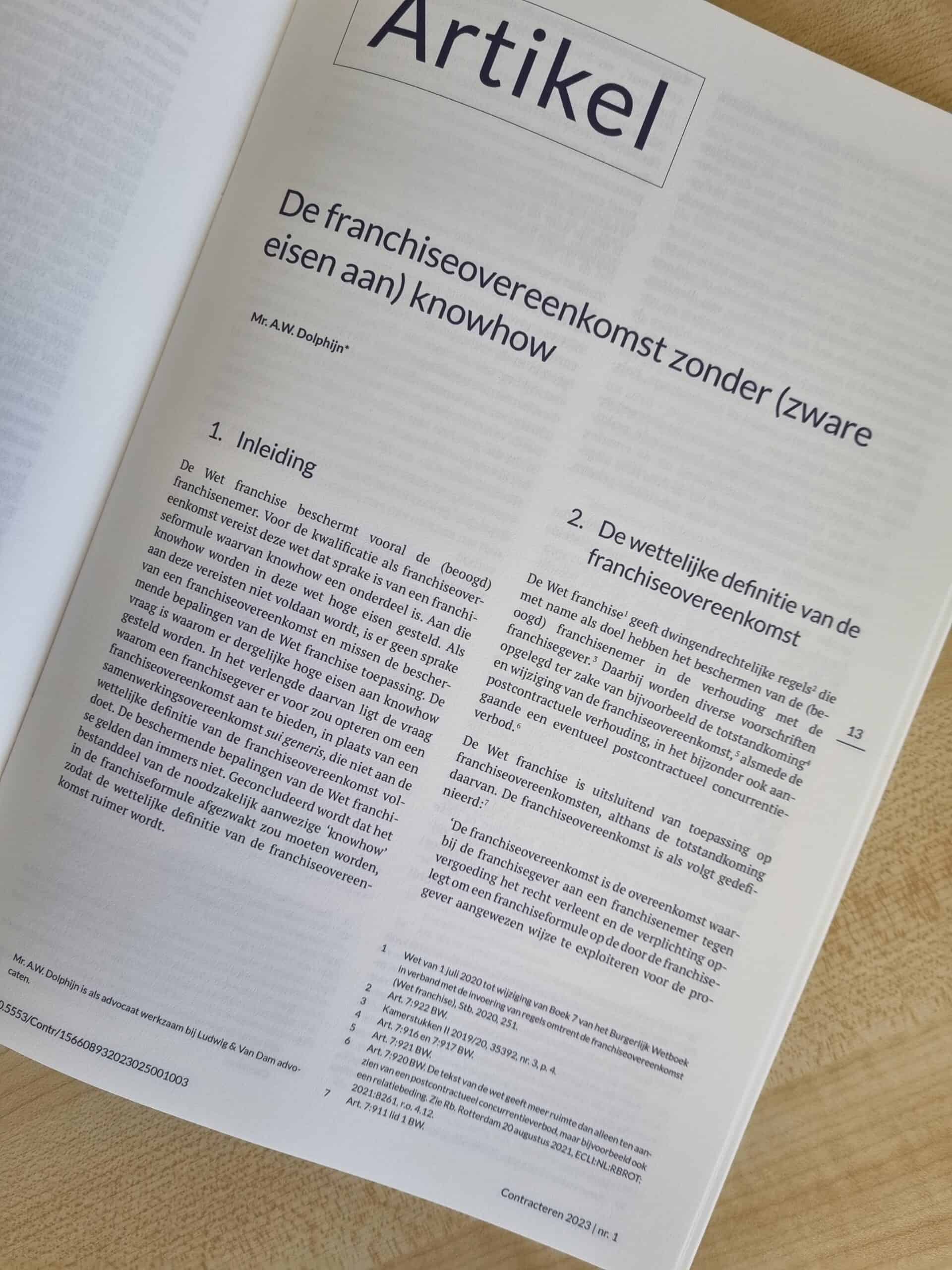
The franchise agreement without (heavy demands on) know-how
In the 2023-1 edition of Contracting magazine, I published a contribution entitled: “The franchise agreement without (strict requirements for) know-how”.
For the qualification as a franchise agreement, the Franchise Act requires that there is a franchise formula of which know-how is a part. This law places high demands on this know-how. If these requirements are not met, there is no franchise agreement and the protective provisions of the Franchise Act are missing. The question is why such high demands are placed on know-how. It is concluded that the element of the necessarily present ‘know-how’ in the franchise formula should be weakened, so that the legal definition of the franchise agreement becomes broader.
The article can be ordered here from the publisher Boom Uitgevers.
Ludwig & Van Dam lawyers, franchise legal advice.
Do you want to respond? Then email to dolphijn@ludwigvandam.nl
Other messages
NFV course for franchisees by mr. Th.R. Ludwig
NFV course for franchisees by mr. Th.R. Ludwig
Incorrect prognosis from Albert Heijn to ex-C1000 franchisee
On December 3, 2014, the District Court of the Northern Netherlands ruled on a dispute in which the attorneys of the Supermarkets section of Ludwig & Van Dam assisted a former C1000 entrepreneur


Supermarket letter – 8
Incorrect prognosis from Albert Heijn to ex-C1000 franchisee
Urgent interest in summary proceedings
In the event of legal disputes, it is possible to request the court to take provisional measures by means of summary proceedings.
Suspension of the fee by the franchisee is not in itself an automatic ground for suspension of goods deliveries by the franchisor
The court in Assen recently ruled that a franchisor had wrongly suspended the deliveries of goods.
Codification or self-regulation in the franchising sector
Codification or self-regulation in the franchising sector