

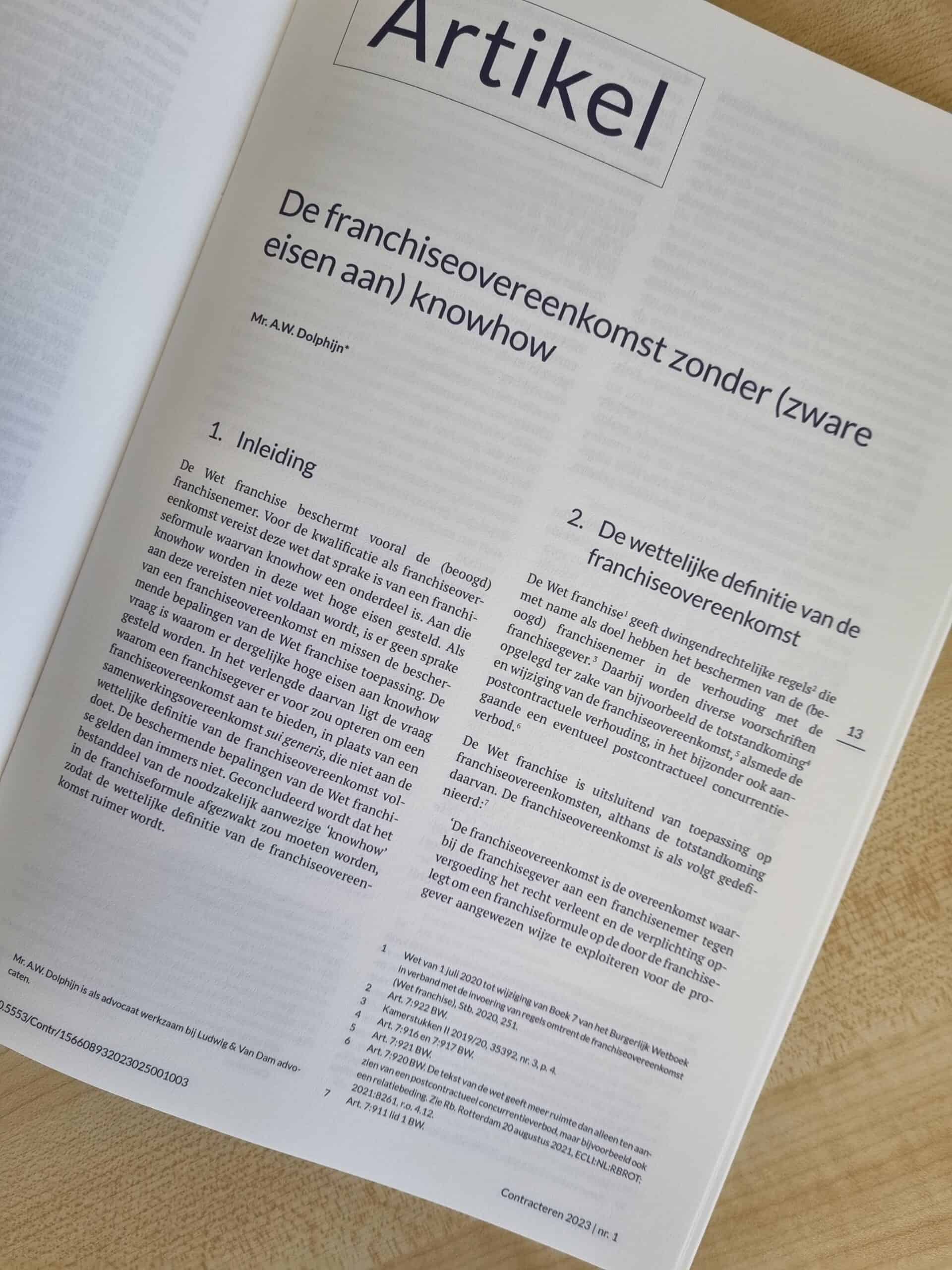
The franchise agreement without (heavy demands on) know-how
In the 2023-1 edition of Contracting magazine, I published a contribution entitled: “The franchise agreement without (strict requirements for) know-how”.
For the qualification as a franchise agreement, the Franchise Act requires that there is a franchise formula of which know-how is a part. This law places high demands on this know-how. If these requirements are not met, there is no franchise agreement and the protective provisions of the Franchise Act are missing. The question is why such high demands are placed on know-how. It is concluded that the element of the necessarily present ‘know-how’ in the franchise formula should be weakened, so that the legal definition of the franchise agreement becomes broader.
The article can be ordered here from the publisher Boom Uitgevers.
Ludwig & Van Dam lawyers, franchise legal advice.
Do you want to respond? Then email to dolphijn@ludwigvandam.nl
Other messages
Rental price change
Following on from earlier published articles of my hand, I will once again deal with a tenancy law issue below.
Franchise Fees
An extremely important subject for both the franchisee and the franchisor that is invariably included in the franchise agreement concerns the franchise fees, often referred to as the term
Insured and well
Occasionally, a franchise agreement contains a clause that obliges the franchisee to take out legal expenses insurance.
Rayon protection II: limitation of the exclusive area.
As a follow-up to the contribution in the previous Newsletter, this time the (possibilities of) curtailment of the exclusive franchise area will be discussed. In most franchise agreements
Franchise Agreements and Terms and Conditions
Franchise agreements often include concise arrangements with regard to delivery and payment conditions.
Horizontal and vertical cooperation
In practice, purchasing organisations, whether or not in the form of a cooperative, sometimes function - partly - as a sales organisation.