

The organizational structure of a franchisor
Earlier installments of this section have already discussed the consequences of a bankruptcy of the franchisor for the franchisees. They are of many kinds. Consideration was given to problems that may arise when the supplier of goods and services is a different entity than the contracting party with whom the franchise agreement has been concluded. Such a construction blocks the settlement of a claim from the franchisor’s side on account of, for example, unpaid goods and services against a claim of the franchisee against the franchisor on account of, for example, failed forecasts or other damage. Identification of both legal entities is an exception.
However, this theme touches on a much broader issue that is indirectly also addressed in the European Code of Honor on Franchising, namely the principle that a franchisor “is who he says he is”. In general, it is highly recommended, and good franchisor practice, to ensure that the entity with whom the franchisee enters into the franchise agreement is actually the accountable party for all matters related to the franchise relationship. It follows from the nature of the franchise agreement, and the related duty of care of a franchisor, that a franchisee must be able to address his franchisor at any time without hesitation, without first considering whether the matter he wishes to discuss is now has to do with delivered goods, forecasts, exclusive territory or whatever. Naturally, a franchisor can use contract suppliers. In that case, however, it must be made clear that the supplier concerned is a third party that independently concludes a supply agreement with the franchisees involved.
If work is done in accordance with the above, the franchisee knows at all times exactly who he is dealing with and where he stands. In principle, this also prevents a franchisor from being too tempted to use “empty” BVs, which, should a franchisee claim liability, ultimately offer no recourse. Such a state of affairs does not do justice to the nature of franchising as a form of cooperation. Incidentally, this reasoning also applies vice versa for the franchisee: he too should not hide behind legal personal constructions that stand in the way of both accountability and liability.
Ludwig & Van Dam franchise attorneys, franchise legal advice

Other messages

Late notification that no franchise agreement will be concluded
On April 11, 2017, EQLI:NL:GHARL:2017:3104, the Amsterdam-Leeuwarden Court of Appeal not only assessed the question of whether the negotiations on a franchise agreement to be concluded
Want to get rid of your franchise agreement in the meantime?
Franchise agreements are usually concluded for a longer period of time. How do you break open a franchise agreement?

HEMA in conflict with franchisees about e-commerce agreements
On 18 July 2018, the District Court of Amsterdam, ECLI:NL:RBAMS:2018:5098, rendered a judgment in proceedings on the merits in which the franchisees were largely ruled in favor of e-commerce.
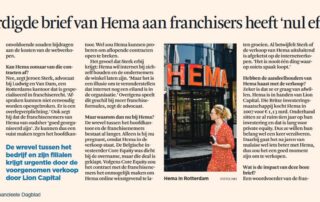
mr. J. Sterk about HEMA conflict in the FD 18 July 2018
mr. J. Sterk about HEMA conflict in the FD.

Column Franchise+ – “Legal Franchise Statistics 2018”
The Legal Franchise Statistics have been compiled for 10 years by Ludwig & Van Dam attorneys on the basis of all published judgments of judges.






Franchisor prohibits opening (franchise) company
A franchisor applied for interim measures to prohibit a franchisee from opening a franchisee's business.